产品: beta Catenin 抗体
货号: AF6266
描述: Rabbit polyclonal antibody to beta Catenin
应用: WB IHC IF/ICC
文献验证: WB, IHC, IF/ICC
反应: Human, Mouse, Rat
预测: Pig, Zebrafish, Bovine, Horse, Sheep, Rabbit, Dog, Chicken, Xenopus
蛋白号: P35222
RRID: AB_2835124

浏览相似产品>>

   规格 价格 库存
 50ul RMB¥ 1000 1250 现货
 100ul RMB¥ 1840 2300 现货
 200ul RMB¥ 3000 现货

货期: 当天发货

联系销售

产品描述

来源:
Rabbit
应用:
WB 1:500-1:2000, IHC 1:50-1:200, IF/ICC 1:200
*The optimal dilutions should be determined by the end user. For optimal experimental results, antibody reuse is not recommended.
*Tips:

WB: 适用于变性蛋白样本的免疫印迹检测. IHC: 适用于组织样本的石蜡(IHC-p)或冰冻(IHC-f)切片样本的免疫组化/荧光检测. IF/ICC: 适用于细胞样本的荧光检测. ELISA(peptide): 适用于抗原肽的ELISA检测.

反应:
Human, Mouse, Rat
克隆:
Polyclonal
特异性:
beta Catenin Antibody detects endogenous levels of total beta Catenin.
RRID:
AB_2835124
引用格式: Affinity Biosciences Cat# AF6266, RRID:AB_2835124.
偶联:
Unconjugated.
纯化:
The antiserum was purified by peptide affinity chromatography using SulfoLink™ Coupling Resin (Thermo Fisher Scientific).
保存:
1mg/ml in PBS, pH 7.4. Store at -20 °C. Stable for 12 months from date of receipt.
别名:

展开/折叠

Beta catenin; Beta-catenin; Cadherin associated protein; Catenin (cadherin associated protein), beta 1, 88kDa; Catenin beta 1; Catenin beta-1; CATNB; CHBCAT; CTNB1_HUMAN; CTNNB; CTNNB1; DKFZp686D02253; FLJ25606; FLJ37923; OTTHUMP00000162082; OTTHUMP00000165222; OTTHUMP00000165223; OTTHUMP00000209288; OTTHUMP00000209289;

抗原和靶标

免疫原:

A synthesized peptide derived from human beta Catenin, corresponding to a region within N-terminal amino acids.

基因/基因ID:
描述:
Beta-catenin is an adherens junction protein. Adherens junctions (AJs; also called the zonula adherens) are critical for the establishment and maintenance of epithelial layers, such as those lining organ surfaces. AJs mediate adhesion between cells, communicate a signal that neighboring cells are present, and anchor the actin cytoskeleton. In serving these roles, AJs regulate normal cell growth and behavior.

研究领域

· Cellular Processes > Cellular community - eukaryotes > Focal adhesion.   (View pathway)

· Cellular Processes > Cellular community - eukaryotes > Adherens junction.   (View pathway)

· Cellular Processes > Cellular community - eukaryotes > Signaling pathways regulating pluripotency of stem cells.   (View pathway)

· Environmental Information Processing > Signal transduction > Rap1 signaling pathway.   (View pathway)

· Environmental Information Processing > Signal transduction > Wnt signaling pathway.   (View pathway)

· Environmental Information Processing > Signal transduction > Hippo signaling pathway.   (View pathway)

· Human Diseases > Infectious diseases: Bacterial > Bacterial invasion of epithelial cells.

· Human Diseases > Infectious diseases: Bacterial > Pathogenic Escherichia coli infection.

· Human Diseases > Infectious diseases: Viral > Human papillomavirus infection.

· Human Diseases > Infectious diseases: Viral > HTLV-I infection.

· Human Diseases > Cancers: Overview > Pathways in cancer.   (View pathway)

· Human Diseases > Cancers: Overview > Proteoglycans in cancer.

· Human Diseases > Cancers: Specific types > Colorectal cancer.   (View pathway)

· Human Diseases > Cancers: Specific types > Endometrial cancer.   (View pathway)

· Human Diseases > Cancers: Specific types > Prostate cancer.   (View pathway)

· Human Diseases > Cancers: Specific types > Thyroid cancer.   (View pathway)

· Human Diseases > Cancers: Specific types > Basal cell carcinoma.   (View pathway)

· Human Diseases > Cancers: Specific types > Breast cancer.   (View pathway)

· Human Diseases > Cancers: Specific types > Hepatocellular carcinoma.   (View pathway)

· Human Diseases > Cancers: Specific types > Gastric cancer.   (View pathway)

· Human Diseases > Cardiovascular diseases > Arrhythmogenic right ventricular cardiomyopathy (ARVC).

· Organismal Systems > Immune system > Leukocyte transendothelial migration.   (View pathway)

· Organismal Systems > Endocrine system > Melanogenesis.

· Organismal Systems > Endocrine system > Thyroid hormone signaling pathway.   (View pathway)

文献引用

1). A Nucleophilicity-Engineered DNA Ligation Blockade Nanoradiosensitizer Induces Irreversible DNA Damage to Overcome Cancer Radioresistance. Advanced materials (Deerfield Beach, Fla.), 2024 (PubMed: 39246208) [IF=27.4]

2). A Single-Cell RNA Sequencing Guided Multienzymatic Hydrogel Design for Self-Regenerative Repair in Diabetic Mandibular Defects. Advanced materials (Deerfield Beach, Fla.), 2024 (PubMed: 39436107) [IF=27.4]

3). Exercise-induced Musclin determines the fate of fibro-adipogenic progenitors to control muscle homeostasis. Cell stem cell, 2024 (PubMed: 38232727) [IF=19.8]

4). MicroRNA-200c impairs uterine receptivity formation by targeting FUT4 and α1,3-fucosylation. CELL DEATH AND DIFFERENTIATION, 2017 (PubMed: 28914881) [IF=13.7]

Application: WB    Species: human    Sample:

Figure 4 miR-200c decreases α1,3-fucosylation on CD44 and inactivates Wnt/β-catenin signaling pathway. (a, e) Western/lectin blot analysis of effect of miR-200c on α1,3- fucosylation and LeY biosynthesis in RL95-2 (a) and Ishikawa (e) cells. CBB: coomassie brilliant blue. LTL: Lotus tetragonolobus lectin. (b, f) Immunoprecipitation and western blot analysis of α 1,3-fucosylation and LeY on CD44 in RL95-2 (b) and Ishikawa (f) cells. Immunoprecipitation (IP): anti-CD44 antibody pulled down protein. Immune blot (IB): detection of α 1,3-fucosylation by LTL lectin and anti-LeY antibody. (c, g) Western blot analysis of CD44, LTL and LeY blocking on activation of p-GSK3β, GSK3β and β-catenin in RL95-2 (c) and Ishikawa (g) cells. (d, h) Western blot and statistical analysis of p-GSK3β, GSK3β and β-catenin in RL95-2 (d) and Ishikawa (h) cells. DKK: inhibitor of Wnt/β- catenin signal pathway. *Po0.05, **Po0.01, ***Po0.

5). Target deubiquitinase OTUB1 as a therapeatic strategy for BLCA via β-catenin/necroptosis signal pathway. International journal of biological sciences, 2024 (PubMed: 39113709) [IF=8.2]

Application: WB    Species: Mouse    Sample:

Figure 4. OTUB1 interacts with β-catenin and regulates its stability. A. Heatmap of RNA-seq expression data for EJ cell transfected with control or shOTUB1 lentivirus. B. GSEA of RNA-seq data revealed that OTUB1 target genes were involved in Wnt/β-catenin signaling pathway. C, D. Relative expression of β-catenin following overexpressed or knockdown OTUB1. E. Relative expression of β-catenin following overexpressed or knockdown OTUB1 (treated with or without MG132 for 8h). F. Relative expression of β-catenin following overexpressed or knockdown OTUB1 (treated with MG132 or chloroquine for 8h). G. Relative expression of β-catenin following overexpressed or knockdown OTUB1 (treated with or without CHX for 0h, 4h, 8h and 24h). H. Relative mRNA expression of OTUB1 and β-catenin following knockdown OTUB1. I. The interaction between OTUB1 and β-catenin was determined by a co-immunoprecipitation assay.

6). Targeting the MDK/c-Myc complex to overcome temozolomide resistance in glioma. Clinical and translational medicine, 2025 (PubMed: 40468625) [IF=7.9]

Application: WB    Species: Mouse    Sample:

FIGURE 4 MDK affects the ubiquitination modification of c-Myc and the Wnt/β-catenin signalling pathway. (A–C) Results from proteomic analysis indicated that MDK affected the Wnt/β-catenin signalling pathway and protein ubiquitination. The raw data are shown in Table S8. (A) Volcano plot analysis results showed differentially expressed proteins (Table S9). The red dots represent upregulated expression in the siMDK group compared with the control group, and the yellow dots represent downregulated expression in the siMDK group compared with the control group. (B) Cluster analysis results showed similarities and differences among the groups (control vs. siMDK) and the stability of the mass spectrometry results of the three repeated experiments (Table S10). (C) KEGG pathway enrichment analysis revealed the signalling pathway affected by MDK knockdown (Table S11). (D) After treatment with 10 mM MG132 for 4 h, siMDK-U118MG and siMDK-SF126 cell lysates were immunoprecipitated with c-Myc and immunoblotted with ubiquitination antibodies. (E) After treatment with 10 mM MG132 for 4 h, OE-MDK-SHG44 and OE-MDK-U87 cell lysates were immunoprecipitated with c-Myc and immunoblotted with ubiquitination antibodies. (F–G) 50 mg/mL cycloheximide was added (at different time points: 0, 2, 4, 6, and 8 h) to glioma cells transfected with siRNA to block protein synthesis. The expression of c-Myc was then detected by Western blot. (H) MDK knockdown was performed on SF126, U118MG, and U251, and then a Western blot was used to detect the Wnt/β-catenin signalling pathway and EMT pathway markers. (I) MDK was overexpressed in U87, BT325, and SHG44, and Western blot was used to detect the Wnt/β-catenin signalling pathway and EMT pathway markers.

7). Cigarette smoke disrupts osteogenic-adipogenic balance via Nrf2/HERC2 axis-driven ferroptosis. Free radical biology & medicine, 2025 (PubMed: 40939850) [IF=7.1]

8). Anti-Obesity Effects of Adzuki Bean Saponins in Improving Lipid Metabolism Through Reducing Oxidative Stress and Alleviating Mitochondrial Abnormality by Activating the PI3K/Akt/GSK3β/β-Catenin Signaling Pathway. Antioxidants (Basel, Switzerland), 2024 (PubMed: 39594522) [IF=7.0]

9). Oxysterol-binding protein-like 2 contributes to the developmental progression of preadipocytes by binding to β-catenin. Cell Death Discovery, 2021 (PubMed: 34001864) [IF=7.0]

Application: WB    Species: Human    Sample: HEK293T cells

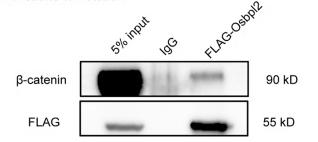
Fig. 2 OSBPL2/ORP2 binds to β-catenin. A Mass spectrometry data of the HEK293T cells expressing FLAG-tagged OSBPL2 were used to identify and evaluated the OSBPL2 interactome and categorized its components by COG and KEGG analyses. B 3T3-L1 preadipocytes were transfected with FLAG-tagged Osbpl2 plasmid for 48 h. Co-IP assays were used to verify the interaction of FLAG-tagged OSBPL2 with endogenous β-catenin in 3T3-L1 preadipocytes. C Panoramic view (right) and amplified view (left) showing the bond between β-catenin (green) and OSBPL2 (rose red). Binding sites 1, ORD in OSBPL2 (Asp-310, Gly-359) and Arm repeats in β-catenin (Ser-351 and Ser-352 residues); binding sites 2, ORD in OSBPL2 (Gln-375, Pro-370, and Thr-368 residues) and Arm repeats in β-catenin (Tyr-604, Pro-606, and Ile-607 residues). D Schematic representing the OSBPL2, β-catenin, and truncated proteins. E Co-IP assays were used to verify the interaction of OSBPL2 with β-catenin or the truncated (N-terminal, SRP, and C-terminal) fractions in HEK293T cells. HEK293T cells co-expressing the truncated HA-tagged (N-terminal) β-catenin and FLAG-tagged OSBPL2 were used as negative controls. F Co-IP assays were used to verify the interaction of β-catenin with the truncated OSBPL2 (ORD). HEK293T cells expressing HA-tagged β-catenin only were used as a negative control. G Co-IP assays were used to verify the interaction of the ORD of OSBPL2 with β-catenin or truncated (SRP or C-terminal) fraction. HEK293T cells expressing HA-tagged β-catenin only were used as a negative control. All data are from three independent experiments. The data are presented as the mean ± SD values (n ≥ 3). ***P < 0.001.

10). NSUN2 regulates Wnt signaling pathway depending on the m5C RNA modification to promote the progression of hepatocellular carcinoma. Oncogene, 2024 (PubMed: 39375506) [IF=6.9]

加载更多

限制条款

产品的规格、报价、验证数据请以官网为准,官网链接:www.affbiotech.com | www.affbiotech.cn(简体中文)| www.affbiotech.jp(日本語)

产品的数据信息为Affinity所有,未经授权不得收集Affinity官网数据或资料用于商业用途,对抄袭产品数据的行为我们将保留诉诸法律的权利。

产品相关数据会因产品批次、产品检测情况随时调整,如您已订购该产品,请以订购时随货说明书为准,否则请以官网内容为准,官网内容有改动时恕不另行通知。

Affinity保证所销售产品均经过严格质量检测。如您购买的商品在规定时间内出现问题需要售后时,请您在Affinity官方渠道提交售后申请。

产品仅供科学研究使用。不用于诊断和治疗。 

产品未经授权不得转售。

Affinity Biosciences将不会对在使用我们的产品时可能发生的专利侵权或其他侵权行为负责。Affinity Biosciences, Affinity Biosciences标志和所有其他商标所有权归Affinity Biosciences LTD.