产品: CD44 抗体
货号: DF6392
描述: Rabbit polyclonal antibody to CD44
应用: WB IHC IF/ICC
文献验证: WB, IHC, IF/ICC
反应: Human, Mouse, Rat
预测: Pig, Bovine, Horse, Sheep, Rabbit, Dog
蛋白号: P16070
RRID: AB_2838355

浏览相似产品>>

   规格 价格 库存
 50ul RMB¥ 1250 现货
 100ul RMB¥ 2300 现货
 200ul RMB¥ 3000 现货

货期: 当天发货

联系销售

产品描述

来源:
Rabbit
应用:
WB 1:500-1:2000, IHC 1:50-1:200, IF/ICC 1:100-1:500
*The optimal dilutions should be determined by the end user. For optimal experimental results, antibody reuse is not recommended.
*Tips:

WB: 适用于变性蛋白样本的免疫印迹检测. IHC: 适用于组织样本的石蜡(IHC-p)或冰冻(IHC-f)切片样本的免疫组化/荧光检测. IF/ICC: 适用于细胞样本的荧光检测. ELISA(peptide): 适用于抗原肽的ELISA检测.

反应:
Human, Mouse, Rat
克隆:
Polyclonal
特异性:
CD44 Antibody detects endogenous levels of total CD44.
RRID:
AB_2838355
引用格式: Affinity Biosciences Cat# DF6392, RRID:AB_2838355.
偶联:
Unconjugated.
纯化:
The antiserum was purified by peptide affinity chromatography using SulfoLink™ Coupling Resin (Thermo Fisher Scientific).
保存:
Rabbit IgG in phosphate buffered saline , pH 7.4, 150mM NaCl, 0.02% sodium azide and 50% glycerol. Store at -20 °C. Stable for 12 months from date of receipt.
别名:

展开/折叠

LHR; BA-1; CD 44; CD44; CD44 antigen; CD44 molecule (Indian blood group); CD44 molecule; CD44_HUMAN; CDw44; Cell surface glycoprotein CD44; chondroitin sulfate proteoglycan 8; CSPG8; ECMR-III; Epican; Extracellular matrix receptor III; GP90 lymphocyte homing/adhesion receptor; HCELL; hematopoietic cell E- and L-selectin ligand; Heparan sulfate proteoglycan; Hermes antigen; homing function and Indian blood group system; HSA; HUTCH-I; HUTCH1; Hyaluronate receptor; IN; INLU-related p80 Glycoprotein; MC56; MDU2; MDU3; MGC10468; MIC4; MUTCH1; PGP-1; PGP-I; PGP1; Phagocytic glycoprotein 1; Phagocytic glycoprotein I; Soluble CD44;

抗原和靶标

免疫原:

A synthesized peptide derived from human CD44, corresponding to a region within the internal amino acids.

基因/基因ID:
描述:
CD44 is a type I transmembrane glycoprotein that mediates cell-cell and cell-matrix interaction through its affinity for hyaluronic acid (HA) and possibly through other parts of the extracellular matrix (ECM). CD44 is highly polymorphic, possesses a number of alternative splice variants and undergoes extensive post-translational modifications (1,2). Increased surface levels of CD44 are characteristic of T cell activation, and expression of the protein is upregulated during the inflammatory response. Interactions between CD44 and HER2 have been linked to an increase in ovarian carcinoma cell growth (1-3). CD44 interacts with ezrin, radixin and moesin (ERM), linking the actin cytoskeleton to the plasma membrane and the ECM (4-6). CD44 is constitutively phosphorylated at Ser325 in resting cells. Activation of PKC results in phosphorylation of Ser291, dephosphorylation of Ser325, disassociation of ezrin from CD44, and directional motility (4).

研究领域

· Environmental Information Processing > Signaling molecules and interaction > ECM-receptor interaction.   (View pathway)

· Human Diseases > Infectious diseases: Bacterial > Shigellosis.

· Human Diseases > Infectious diseases: Viral > Epstein-Barr virus infection.

· Human Diseases > Cancers: Overview > Proteoglycans in cancer.

· Human Diseases > Cancers: Overview > MicroRNAs in cancer.

· Organismal Systems > Immune system > Hematopoietic cell lineage.   (View pathway)

文献引用

1). Metabolic reprogramming of proinflammatory macrophages by target delivered roburic acid effectively ameliorates rheumatoid arthritis symptoms. Signal Transduction and Targeted Therapy, 2023 (PubMed: 37500654) [IF=40.8]

Application: IF/ICC    Species: Mouse    Sample: RAW264.7 cells

Fig. 2 RBA-NPs display targeting capability in vitro. a, b Confocal micrographs showed that DiD-NPs (red) enjoyed significantly improved cell uptake compared with free DiD in LPS + IFN-γ activated RAW264.7 cells. Scale bar = 10 μm. c Flow cytometry analysis showed that the fluorescence intensity of DiD-NPs in LPS + IFN-γ activated RAW264.7 cells was higher than that of free DiD in RAW264.7. d The expression of CD44 and folate receptors increased significantly on the surface of LPS + IFN-γ activated RAW264.7 cells (d). Scale bar = 10 μm. e LPS + IFN-γ activated macrophages were pretreated with HA or FA or both HA and FA to compete for the overexpressed CD44 or folate receptors, and cellular uptake of DiD-NPs was reduced. f Confocal micrographs showed co-localization of DiD-NPs (orange) with CD44 receptor (red) and folate receptor (green). Scale bar = 20 μm. Cell nuclei was stained with DAPI (blue). All results are shown as mean ± SD. *P 

2). The heterogeneous immune landscape between lung adenocarcinoma and squamous carcinoma revealed by single-cell RNA sequencing. Signal transduction and targeted therapy, 2022 (PubMed: 36008393) [IF=40.8]

3). Mas Signaling Potentiates Neutrophil Extracellular Traps Formation Induced by Endothelial Cells Derived S1P in Mice with Acute Liver Failure. Advanced science (Weinheim, Baden-Wurttemberg, Germany), 2025 (PubMed: 40285622) [IF=15.1]

4). HYD-PEP06 suppresses hepatocellular carcinoma metastasis, epithelial–mesenchymal transition and cancer stem cell-like properties by inhibiting PI3K/AKT and WNT/β-catenin signaling activation. Acta Pharmaceutica Sinica B, 2021 (PubMed: 34221870) [IF=14.7]

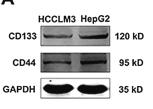
Application: WB    Species: Human    Sample: HepG2 cells

Figure 5 Tumor spheres isolated from hepatocellular carcinoma HepG2 cells obtained the characteristics of cancer stem cells. (A) Comparison of the protein levels of CD133 and CD44 in HCCLM3 and HepG2 cells. The protein expression of (B) CD133 and (C) CD44 was dramatically increased in HepG2 cells compared with those in HCCLM3 cells. ∗P < 0.05, compared with the HCCLM3 cells. (D) The images of 3D tumor spheroids were captured using the fluorescence microscope on Day 0 in attachment surface plates and Days 0, 3, 5, 7, and 10 in ultra-low attachment surface plates with CSC medium (magnification 200 ×); scale bar: 20 μm. (E) The protein expression of CD133 and CD44 was analyzed by Western blot in HepG2 and CSC-like cells. The protein expression of (F) CD133 and (G) CD44 was dramatically increased in CSC-like cells compared with HepG2 cells. Data are presented as mean ± SEM; ∗P < 0.05, ∗∗P < 0.01. (H) The expression of CD133 and CD44 were assessed by immunofluorescence staining in HepG2 and tumor sphere cells. Blue represents DAPI; green represents CD44; red represents CD133. Magnification: 400 ×. (I) CSC augments tumor-initiating in vivo. Representative xenograft tumors derived from CSC-like cells compared to HepG2 cells after two weeks subcutaneous injection in nude mice (n = 3). Left panel: HepG2 cells; right: CSCs. (J) The protein levels of CD133 and CD44 were analyzed by Western blot in the tumor tissues isolated from xenograft models. GAPDH served as a sample loading control. The protein levels of CSC markers (K) CD133 and (L) CD44 were dramatically upregulated in right tissues compared with left tissues. Data are presented as mean ± SEM; ∗P < 0.05, ∗∗∗P < 0.001.

5). Exosomes of human adipose stem cells mitigate irradiation injury to salivary glands by inhibiting epithelial-mesenchymal transition through miR-199a-3p targeting Twist1 and regulating TGFβ1/Smad3 pathway. Theranostics, 2025 (PubMed: 39897544) [IF=12.4]

6). CD44‐targeting Drug Delivery System of Exosomes Loading Forsythiaside A Combats Liver Fibrosis via Regulating NLRP3‐mediated Pyroptosis. Advanced Healthcare Materials, 2023 (PubMed: 36603210) [IF=10.0]

7). ZIF-8 Modified Multifunctional Bone-Adhesive Hydrogels Promoting Angiogenesis and Osteogenesis for Bone Regeneration. ACS Applied Materials & Interfaces, 2020 (PubMed: 32814397) [IF=8.3]

8). Targeting TNFAIP2 with NIR-II CRISPR-Cas9 nanosystem to overcome cisplatin resistance in laryngeal cancer. NPJ precision oncology, 2025 (PubMed: 40731142) [IF=7.9]

9). GSH-responsive targeted copper-based nanoparticle improve ovarian cancer treatment via induction of apoptosis-ferroptosis-cuproptosis. MATERIALS & DESIGN, 2025 [IF=7.6]

Application: WB    Species: human    Sample:

Fig. 3. Targeting ability of HTC@DOX. (A) Boxplot of CD44 expression difference between OC tumour and normal tissues using GEPIA (http://gepia.cancer-pku.cn/). The red and gray box respectively represent tumour and normal tissues. (B) CD44 protein expression level of ID8, NRK-49F, AML-12 and H9c2 cells, *compared to the ID8 group (n = 3). (C) Fluorescent inverted microscope images and quantitative of ID8 cells incubated with HTC@DOX and HA + HTC@DOX for 6 h (scale = 20 μm), *compared to the HA + HTC@DOX group (n = 3). (D) Fluorescent images of tumour-bearing mice at different time points and various organs and tumours at 24 h after tail vein injection of fluorescent dye DIR and DIR-loaded nanoparticle HT@DIR (n = 5). (E) Quantitative graph of fluorescence intensity of tumour from tumour-bearing mice at different time points (n = 5), *compared to the DIR group.

10). Ginsenoside Rg1 prevents bone marrow mesenchymal stem cell senescence via NRF2 and PI3K/Akt signaling. Free radical biology & medicine, 2021 (PubMed: 34364981) [IF=7.1]

加载更多

限制条款

产品的规格、报价、验证数据请以官网为准,官网链接:www.affbiotech.com | www.affbiotech.cn(简体中文)| www.affbiotech.jp(日本語)

产品的数据信息为Affinity所有,未经授权不得收集Affinity官网数据或资料用于商业用途,对抄袭产品数据的行为我们将保留诉诸法律的权利。

产品相关数据会因产品批次、产品检测情况随时调整,如您已订购该产品,请以订购时随货说明书为准,否则请以官网内容为准,官网内容有改动时恕不另行通知。

Affinity保证所销售产品均经过严格质量检测。如您购买的商品在规定时间内出现问题需要售后时,请您在Affinity官方渠道提交售后申请。

产品仅供科学研究使用。不用于诊断和治疗。 

产品未经授权不得转售。

Affinity Biosciences将不会对在使用我们的产品时可能发生的专利侵权或其他侵权行为负责。Affinity Biosciences, Affinity Biosciences标志和所有其他商标所有权归Affinity Biosciences LTD.