产品: N Cadherin 抗体
货号: AF5239
描述: Rabbit polyclonal antibody to N Cadherin
应用: WB IHC IF/ICC
文献验证: WB, IHC, IF/ICC
反应: Human, Mouse, Rat
预测: Pig, Zebrafish, Bovine, Horse, Sheep, Rabbit, Dog, Chicken, Xenopus
蛋白号: P19022
RRID: AB_2837725

浏览相似产品>>

   规格 价格 库存
 50ul RMB¥ 1000 1250 现货
 100ul RMB¥ 1840 2300 现货
 200ul RMB¥ 3000 现货

货期: 当天发货

联系销售

产品描述

来源:
Rabbit
应用:
WB 1:500-1:2000, IF/ICC 1:100-1:500, IHC 1:50-1:200
*The optimal dilutions should be determined by the end user. For optimal experimental results, antibody reuse is not recommended.
*Tips:

WB: 适用于变性蛋白样本的免疫印迹检测. IHC: 适用于组织样本的石蜡(IHC-p)或冰冻(IHC-f)切片样本的免疫组化/荧光检测. IF/ICC: 适用于细胞样本的荧光检测. ELISA(peptide): 适用于抗原肽的ELISA检测.

反应:
Human, Mouse, Rat
克隆:
Polyclonal
特异性:
N Cadherin Antibody detects endogenous levels of total N Cadherin.
RRID:
AB_2837725
引用格式: Affinity Biosciences Cat# AF5239, RRID:AB_2837725.
偶联:
Unconjugated.
纯化:
The antiserum was purified by peptide affinity chromatography using SulfoLink™ Coupling Resin (Thermo Fisher Scientific).
保存:
Rabbit IgG in phosphate buffered saline , pH 7.4, 150mM NaCl, 0.02% sodium azide and 50% glycerol. Store at -20 °C. Stable for 12 months from date of receipt.
别名:

展开/折叠

CADH2_HUMAN; Cadherin 2; Cadherin 2 N cadherin neuronal; Cadherin 2 type 1; Cadherin 2 type 1 N cadherin neuronal; Cadherin 2, type 1, N-cadherin (neuronal); Cadherin-2; Cadherin2; Calcium dependent adhesion protein neuronal; CD325; CD325 antigen; CDH2; CDHN; CDw325; CDw325 antigen; N cadherin 1; N-cadherin; NCAD; Neural cadherin; OTTHUMP00000066304; OTTHUMP00000067378;

抗原和靶标

免疫原:

A synthesized peptide derived from human N Cadherin, corresponding to a region within C-terminal amino acids.

基因/基因ID:
描述:
Cadherins are calcium-dependent cell adhesion proteins. They preferentially interact with themselves in a homophilic manner in connecting cells; cadherins may thus contribute to the sorting of heterogeneous cell types. CDH2 may be involved in neuronal recognition mechanism. In hippocampal neurons, may regulate dendritic spine density

研究领域

· Environmental Information Processing > Signaling molecules and interaction > Cell adhesion molecules (CAMs).   (View pathway)

· Human Diseases > Cardiovascular diseases > Arrhythmogenic right ventricular cardiomyopathy (ARVC).

文献引用

1). METTL13 Mediates the Translation of Snail in Head and Neck Squamous Cell Carcinoma. International Journal of Oral Science, 2020 (PubMed: 34381012) [IF=10.8]

2). Prolyl hydroxylase-2 (EGLN1) mediates TGF-β1 pathway regulated epithelial–mesenchymal transition in yak kidneys. International Journal of Biological Macromolecules, 2025 [IF=8.5]

3). SB431542 partially inhibits high glucose-induced EMT by restoring mitochondrial homeostasis in RPE cells. Cell communication and signaling : CCS, 2024 (PubMed: 38183022) [IF=8.4]

4). Deprivation of methionine inhibits osteosarcoma growth and metastasis via C1orf112-mediated regulation of mitochondrial functions. Cell death & disease, 2024 (PubMed: 38769167) [IF=8.1]

5). BRD7 inhibits enhancer activity and expression of BIRC2 to suppress tumor growth and metastasis in nasopharyngeal carcinoma. Cell Death & Disease, 2023 (PubMed: 36788209) [IF=8.1]

Application: WB    Species: Human    Sample: 5-8 F and HNE1 cells

Fig. 5 Restoration of BIRC2 expression reverses the inhibitory effect of BRD7 on cell migration and invasion. A Scratch wound healing analysis of cell migration in 5-8 F and HNE1 cells stably with BRD7 overexpression, BRD7 and BIRC2 simultaneous overexpression or control. Quantification of the wound recovery rate of the three groups (right). B Matrigel invasion analysis of cell invasive capabilities in 5-8 F and HNE1 cells stably with BRD7 overexpression, BRD7 and BIRC2 simultaneous overexpression or control. C Significantly differently expressed proteins involved in EMT progression (E-cadherin, N-cadherin, Vimentin, ZO-1) in BRD7 overexpression, BIRC2 overexpression and BIRC2 restoration cells, respectively. GAPDH served as an internal control. Error bars represent the mean ± SD. *P 

6). Targeting the MDK/c-Myc complex to overcome temozolomide resistance in glioma. Clinical and translational medicine, 2025 (PubMed: 40468625) [IF=7.9]

Application: WB    Species: Mouse    Sample:

FIGURE 4 MDK affects the ubiquitination modification of c-Myc and the Wnt/β-catenin signalling pathway. (A–C) Results from proteomic analysis indicated that MDK affected the Wnt/β-catenin signalling pathway and protein ubiquitination. The raw data are shown in Table S8. (A) Volcano plot analysis results showed differentially expressed proteins (Table S9). The red dots represent upregulated expression in the siMDK group compared with the control group, and the yellow dots represent downregulated expression in the siMDK group compared with the control group. (B) Cluster analysis results showed similarities and differences among the groups (control vs. siMDK) and the stability of the mass spectrometry results of the three repeated experiments (Table S10). (C) KEGG pathway enrichment analysis revealed the signalling pathway affected by MDK knockdown (Table S11). (D) After treatment with 10 mM MG132 for 4 h, siMDK-U118MG and siMDK-SF126 cell lysates were immunoprecipitated with c-Myc and immunoblotted with ubiquitination antibodies. (E) After treatment with 10 mM MG132 for 4 h, OE-MDK-SHG44 and OE-MDK-U87 cell lysates were immunoprecipitated with c-Myc and immunoblotted with ubiquitination antibodies. (F–G) 50 mg/mL cycloheximide was added (at different time points: 0, 2, 4, 6, and 8 h) to glioma cells transfected with siRNA to block protein synthesis. The expression of c-Myc was then detected by Western blot. (H) MDK knockdown was performed on SF126, U118MG, and U251, and then a Western blot was used to detect the Wnt/β-catenin signalling pathway and EMT pathway markers. (I) MDK was overexpressed in U87, BT325, and SHG44, and Western blot was used to detect the Wnt/β-catenin signalling pathway and EMT pathway markers.

Application: WB    Species: Mouse    Sample:

FIGURE 4 MDK affects the ubiquitination modification of c-Myc and the Wnt/β-catenin signalling pathway. (A–C) Results from proteomic analysis indicated that MDK affected the Wnt/β-catenin signalling pathway and protein ubiquitination. The raw data are shown in Table S8. (A) Volcano plot analysis results showed differentially expressed proteins (Table S9). The red dots represent upregulated expression in the siMDK group compared with the control group, and the yellow dots represent downregulated expression in the siMDK group compared with the control group. (B) Cluster analysis results showed similarities and differences among the groups (control vs. siMDK) and the stability of the mass spectrometry results of the three repeated experiments (Table S10). (C) KEGG pathway enrichment analysis revealed the signalling pathway affected by MDK knockdown (Table S11). (D) After treatment with 10 mM MG132 for 4 h, siMDK-U118MG and siMDK-SF126 cell lysates were immunoprecipitated with c-Myc and immunoblotted with ubiquitination antibodies. (E) After treatment with 10 mM MG132 for 4 h, OE-MDK-SHG44 and OE-MDK-U87 cell lysates were immunoprecipitated with c-Myc and immunoblotted with ubiquitination antibodies. (F–G) 50 mg/mL cycloheximide was added (at different time points: 0, 2, 4, 6, and 8 h) to glioma cells transfected with siRNA to block protein synthesis. The expression of c-Myc was then detected by Western blot. (H) MDK knockdown was performed on SF126, U118MG, and U251, and then a Western blot was used to detect the Wnt/β-catenin signalling pathway and EMT pathway markers. (I) MDK was overexpressed in U87, BT325, and SHG44, and Western blot was used to detect the Wnt/β-catenin signalling pathway and EMT pathway markers.

7). TRIML2 promotes malignant progression of head and neck squamous cell carcinoma via canonical Wnt signaling and tumor immune escape. Journal of Translational Medicine, 2025 [IF=7.5]

Application: WB    Species: human    Sample: HNSC cells

Fig. 8 TRIML2 knockdown inhibits the proliferation, migration, and invasion of HNSC cells. (A, B) Western blot and RT-qPCR were used to validate the knockdown efficiency of TRIML2 in HNSC cell lines. (C-F) The proliferative ability was assessed by CCK-8 and EdU assays. (G-H) Migration and invasion ability were measured by wound-healing and transwell assays. (I) the canonical wnt and EMT-related proteins were detected by Western blot after TRIML2 knockdown. All in vitro experiments were performed in at least three independent replicates. The data are presented as the mean ± SD.

8). Huaier polysaccharides suppress triple-negative breast cancer metastasis and epithelial-mesenchymal transition by inducing autophagic degradation of Snail. Cell and Bioscience, 2021 (PubMed: 34481526) [IF=7.5]

9). CDH3 promotes the progression of lung adenocarcinoma through driving epithelial-mesenchymal transition progress. Journal of translational medicine, 2025 (PubMed: 40781712) [IF=7.4]

Application: WB    Species: human    Sample: HCC827 and H1975 cell

Fig. 9 From: CDH3 promotes the progression of lung adenocarcinoma through driving epithelial-mesenchymal transition progress CDH3 knockdown suppressed LUAD malignant phenotype and inhibited pathological EMT. (A) Cell proliferation analysis in CDH3 knockdown HCC827 and H1975 cell lines using CCK8 assay (n = 3). (B) The quantification and representative images of colony formation assays for CDH3 knockdown HCC827 and H1975 cell lines (t-test, n = 3). (C) The quantification and representative images of EdU assays for CDH3 knockdown HCC827 and H1975 cell lines (t-test, n = 3). (D) The quantification and representative images of wound healing assays for CDH3 knockdown HCC827 and H1975 cell lines. (t-test, n = 3). (E) Western blot was used to evaluate the expression levels of the EMT-related markers in for CDH3 knockdown HCC827 and H1975 cell lines. (F-H)Subcutaneous tumors developed from CDH3 knockdown HCC827 cells and control cells.

10). TGF-β1-induced bone marrow mesenchymal stem cells (BMSCs) migration via histone demethylase KDM6B mediated inhibition of methylation marker H3K27me3. Cell Death Discovery, 2022 (PubMed: 35902563) [IF=7.0]

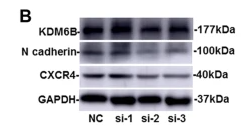
Application: WB    Species: Human    Sample: BMSCs

Fig. 1: The siRNA-KDM6B inhibited the migration of BMSCs in vitro. A The knockdown efficiency of KDM6B was verified by qRT-PCR. B, C The siRNA-KDM6B inhibited the protein expression of migration-related genes (N cadherin and CXCR4). D, E The IF showed the expression of CXCR4 was inhibited by siRNA-KDM6B. F, G The siRNA-KDM6B inhibited the actin cortical protrusions formation of BMSCs. H, I The scratch test showed that siRNA-KDM6B decreased the migration area of BMSCs. J, K Transwell test verified that siRNA-KDM6B inhibited the migrated MSCs number. (si-1: siKDM6B-1, si-2: siKDM6B-2, si-3: siKDM6B-3. *P 

加载更多

限制条款

产品的规格、报价、验证数据请以官网为准,官网链接:www.affbiotech.com | www.affbiotech.cn(简体中文)| www.affbiotech.jp(日本語)

产品的数据信息为Affinity所有,未经授权不得收集Affinity官网数据或资料用于商业用途,对抄袭产品数据的行为我们将保留诉诸法律的权利。

产品相关数据会因产品批次、产品检测情况随时调整,如您已订购该产品,请以订购时随货说明书为准,否则请以官网内容为准,官网内容有改动时恕不另行通知。

Affinity保证所销售产品均经过严格质量检测。如您购买的商品在规定时间内出现问题需要售后时,请您在Affinity官方渠道提交售后申请。

产品仅供科学研究使用。不用于诊断和治疗。 

产品未经授权不得转售。

Affinity Biosciences将不会对在使用我们的产品时可能发生的专利侵权或其他侵权行为负责。Affinity Biosciences, Affinity Biosciences标志和所有其他商标所有权归Affinity Biosciences LTD.