产品: alpha-SMA 抗体
货号: AF1032
描述: Rabbit polyclonal antibody to alpha-SMA
应用: WB IHC IF/ICC IP
文献验证: WB, IHC, IF/ICC
反应: Human, Mouse, Rat, Bovine
预测: Pig, Bovine, Horse, Sheep, Rabbit, Dog, Chicken
蛋白号: P62736
RRID: AB_2835329

浏览相似产品>>

   规格 价格 库存
 50ul RMB¥ 1250 现货
 100ul RMB¥ 2300 现货
 200ul RMB¥ 3000 现货

货期: 当天发货

联系销售

产品描述

来源:
Rabbit
应用:
WB 1:500-1:1000, IHC 1:50-1:500, IF/ICC: 1:200, IP 1:100
*The optimal dilutions should be determined by the end user. For optimal experimental results, antibody reuse is not recommended.
*Tips:

WB: 适用于变性蛋白样本的免疫印迹检测. IHC: 适用于组织样本的石蜡(IHC-p)或冰冻(IHC-f)切片样本的免疫组化/荧光检测. IF/ICC: 适用于细胞样本的荧光检测. ELISA(peptide): 适用于抗原肽的ELISA检测.

反应:
Human, Mouse, Rat, Bovine
克隆:
Polyclonal
特异性:
alpha-SMA Antibody detects endogenous levels of total alpha-SMA.
RRID:
AB_2835329
引用格式: Affinity Biosciences Cat# AF1032, RRID:AB_2835329.
偶联:
Unconjugated.
纯化:
The antiserum was purified by peptide affinity chromatography using SulfoLink™ Coupling Resin (Thermo Fisher Scientific).
保存:
Rabbit IgG in phosphate buffered saline , pH 7.4, 150mM NaCl, 0.02% sodium azide and 50% glycerol.Stable for 15 months from date of receipt. Store at -20 °C. Stable for 12 months from date of receipt.
别名:

展开/折叠

a actin; AAT6; ACTA_HUMAN; ACTA2; Actin alpha 2 smooth muscle aorta; Actin aortic smooth muscle; Actin, aortic smooth muscle; ACTSA; ACTVS; Alpha 2 actin; Alpha actin 2; Alpha cardiac actin; Alpha-actin-2; Cell growth inhibiting gene 46 protein; Cell growth-inhibiting gene 46 protein; GIG46; Growth inhibiting gene 46; MYMY5; Sarcomeric Actin;

抗原和靶标

免疫原:

A synthesized peptide derived from human alpha-SMA, corresponding to a region within N-terminal amino acids.

基因/基因ID:
描述:
Defects in ACTA2 are the cause of aortic aneurysm familial thoracic type 6 (AAT6) [MIM:611788]. AATs are characterized by permanent dilation of the thoracic aorta usually due to degenerative changes in the aortic wall. They are primarily associated with a characteristic histologic appearance known as 'medial necrosis' or 'Erdheim cystic medial necrosis' in which there is degeneration and fragmentation of elastic fibers, loss of smooth muscle cells, and an accumulation of basophilic ground substance.

研究领域

· Environmental Information Processing > Signal transduction > Apelin signaling pathway.   (View pathway)

· Organismal Systems > Circulatory system > Vascular smooth muscle contraction.   (View pathway)

· Organismal Systems > Endocrine system > Relaxin signaling pathway.

文献引用

1). The construction, expression, and enhanced anti-tumor activity of YM101: a bispecific antibody simultaneously targeting TGF-β and PD-L1. Journal of Hematology & Oncology, 2021 (PubMed: 33593403) [IF=28.5]

Application: IHC    Species: Human    Sample:

Fig. 10 Immunohistochemical staining to evaluate the activity of carcinoma-associated fibroblast, the status of mediated epithelial-mesenchymal transition of cancer cells, as well as the proliferation and apoptosis of cancer cells. a H&E staining. b Anti-α-SMA staining. c Picrosirius red staining. d Anti-E-cadherin staining. e Anti-Vimentin staining. f Anti-Ki-67 staining. g Anti-PCNA staining. h Anti-cleaved-Caspase 3. For quantitative analysis, the integral optical density (IOD) of values the IHC stainings were calculated. *p 

2). Upregulation of BCL-2 by acridone derivative through gene promoter i-motif for alleviating liver damage of NAFLD/NASH. NUCLEIC ACIDS RESEARCH, 2020 (PubMed: 32710621) [IF=16.6]

Application: WB    Species: mouse    Sample: liver

Figure 7. Effect of A22 on ameliorating apoptosis, ER stress, inflammation, metabolic syndrome, and fibrogenesis in HF diet-fed mice. (A) Effect of A22 on BCL-2 gene transcription. (B) Effect of A22 on BAX gene transcription. (C) Effect of A22 on expressions of apoptosis-related proteins in liver. The extracted proteins from the liver were immunoblotted with specific antibodies, and quantified based on the loading control of ACTIN. (D) Effect of A22 on ER stress. The UPR proteins (IRE-1, PERK, elF-2 and CHOP) were analyzed by using western Blot. (E) Effect of A22 on expressions of inflammatory factors. (F) Effect of A22 on expressions of fibrogenic proteins.

3). Nephronectin (NPNT) is a Crucial Determinant of Idiopathic Pulmonary Fibrosis: Modulating Cellular Senescence via the ITGA3/YAP1 Signaling Axis. Advanced science (Weinheim, Baden-Wurttemberg, Germany), 2025 (PubMed: 40444575) [IF=15.1]

Application: WB    Species: Mouse    Sample:

Figure 2 NPNT deficiency exacerbated BLM-induced pulmonary fibrosis and pulmonary dysfunction in mice. A) Kaplan-Meier analysis of WT and NPNT+/− mice 3 weeks after Saline or BLM surgery. Saline+WT n = 10, Saline+NPNT+/− n = 10, BLM+WT n = 19, BLM+NPNT+/− n = 22. B) Percentage of weight loss in mice over time after BLM induction. C) Micro-CT imaging showed the shadow area of the mouse lung, and the bottom group was the morphology of mouse lung tissue. n = 4. Scale bars = 2 mm. D) Lung density in Hounsfield units (HU) based on micro-CT images. E) After 3 weeks of Saline or BLM stimulation, the lung function of WT and NPNT+/− mice was tested, including IC, FVC, lung compliance, and flow-volume loop (n = 8–10 per group). F,G) Representative images of H&E and Masson staining of WT and NPNT+/− mice 3 weeks after intratracheal injection of Saline or BLM. Scale bar, 50 µm. H) The pulmonary collagen deposition and myofibroblast formation of WT and NPNT+/− after BLM induction were detected by immunohistochemical staining (Scale bar, 50 µm) and immunofluorescence staining (Scale bar, 20 µm). n = 4 per group. I) The ratio of lung weight to body weight of mice was weighed and calculated (n = 5 per group). J) The content of hydroxyproline in mouse lung tissue was measured to reflect the decomposition of connective tissue (n = 5 per group). K,L) Western blotting and quantification showed protein levels of FN1, α-SMA, and NPNT in WT and NPNT+/− mice after Saline or BLM injection. n = 6 per group. (M) Quantification of mRNA levels of Fn1, Col 1α1, and ACTA2. n = 5 samples per group. Data are presented as mean ± SEM. *p < 0.05, **p < 0.01.

Application: IF/ICC    Species: Mouse    Sample:

Figure 2 NPNT deficiency exacerbated BLM-induced pulmonary fibrosis and pulmonary dysfunction in mice. A) Kaplan-Meier analysis of WT and NPNT+/− mice 3 weeks after Saline or BLM surgery. Saline+WT n = 10, Saline+NPNT+/− n = 10, BLM+WT n = 19, BLM+NPNT+/− n = 22. B) Percentage of weight loss in mice over time after BLM induction. C) Micro-CT imaging showed the shadow area of the mouse lung, and the bottom group was the morphology of mouse lung tissue. n = 4. Scale bars = 2 mm. D) Lung density in Hounsfield units (HU) based on micro-CT images. E) After 3 weeks of Saline or BLM stimulation, the lung function of WT and NPNT+/− mice was tested, including IC, FVC, lung compliance, and flow-volume loop (n = 8–10 per group). F,G) Representative images of H&E and Masson staining of WT and NPNT+/− mice 3 weeks after intratracheal injection of Saline or BLM. Scale bar, 50 µm. H) The pulmonary collagen deposition and myofibroblast formation of WT and NPNT+/− after BLM induction were detected by immunohistochemical staining (Scale bar, 50 µm) and immunofluorescence staining (Scale bar, 20 µm). n = 4 per group. I) The ratio of lung weight to body weight of mice was weighed and calculated (n = 5 per group). J) The content of hydroxyproline in mouse lung tissue was measured to reflect the decomposition of connective tissue (n = 5 per group). K,L) Western blotting and quantification showed protein levels of FN1, α-SMA, and NPNT in WT and NPNT+/− mice after Saline or BLM injection. n = 6 per group. (M) Quantification of mRNA levels of Fn1, Col 1α1, and ACTA2. n = 5 samples per group. Data are presented as mean ± SEM. *p < 0.05, **p < 0.01.

Application: IHC    Species: Mouse    Sample:

Figure 2 NPNT deficiency exacerbated BLM-induced pulmonary fibrosis and pulmonary dysfunction in mice. A) Kaplan-Meier analysis of WT and NPNT+/− mice 3 weeks after Saline or BLM surgery. Saline+WT n = 10, Saline+NPNT+/− n = 10, BLM+WT n = 19, BLM+NPNT+/− n = 22. B) Percentage of weight loss in mice over time after BLM induction. C) Micro-CT imaging showed the shadow area of the mouse lung, and the bottom group was the morphology of mouse lung tissue. n = 4. Scale bars = 2 mm. D) Lung density in Hounsfield units (HU) based on micro-CT images. E) After 3 weeks of Saline or BLM stimulation, the lung function of WT and NPNT+/− mice was tested, including IC, FVC, lung compliance, and flow-volume loop (n = 8–10 per group). F,G) Representative images of H&E and Masson staining of WT and NPNT+/− mice 3 weeks after intratracheal injection of Saline or BLM. Scale bar, 50 µm. H) The pulmonary collagen deposition and myofibroblast formation of WT and NPNT+/− after BLM induction were detected by immunohistochemical staining (Scale bar, 50 µm) and immunofluorescence staining (Scale bar, 20 µm). n = 4 per group. I) The ratio of lung weight to body weight of mice was weighed and calculated (n = 5 per group). J) The content of hydroxyproline in mouse lung tissue was measured to reflect the decomposition of connective tissue (n = 5 per group). K,L) Western blotting and quantification showed protein levels of FN1, α-SMA, and NPNT in WT and NPNT+/− mice after Saline or BLM injection. n = 6 per group. (M) Quantification of mRNA levels of Fn1, Col 1α1, and ACTA2. n = 5 samples per group. Data are presented as mean ± SEM. *p < 0.05, **p < 0.01.

4). The Single-Cell Landscape of Intratumoral Heterogeneity and The Immunosuppressive Microenvironment in Liver and Brain Metastases of Breast Cancer. Advanced science (Weinheim, Baden-Wurttemberg, Germany), 2023 (PubMed: 36529697) [IF=15.1]

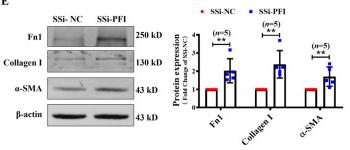
5). The long non-coding RNA PFI protects against pulmonary fibrosis by interacting with splicing regulator SRSF1. CELL DEATH AND DIFFERENTIATION, 2021 (PubMed: 33981019) [IF=13.7]

Application: WB    Species: Mice    Sample: fibrogenesis
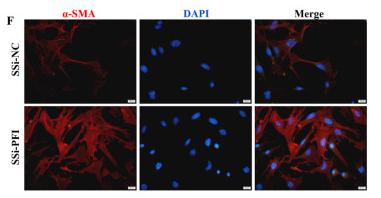
Fig. 1 Knockdown of lncRNA PFI results in fibrogenesis of MLFs. A qRT-PCR analysis showed six upregulated and two downregulated lncRNAs in BLM-treated mice compared to saline-treated mice. B LncRNA NONMMUT060091, which we named lncRNA pulmonary fibrosis inhibitor (lncRNA PFI), was dramatically reduced in TGF-β1-treated mouse lung fibroblasts (MLFs). C, D qRT-PCR assays of relative lncRNA PFI, collagen 1α1, collagen 3α1, Fn1, CTGF, and ACTA2 expression in MLFs treated with SSi-PFI or SSi-NC. E Western blots demonstrated markedly increased expression of fibrosis-related proteins Fn1, Collagen I, and α-SMA in SSi-PFI transfected MLFs. F Immunofluorescence staining of α-SMA suggested acceleration of the fibroblast-myofibroblast transition after silencing of lncRNA PFI; bar = 20 μm; n = 5 independent experiments. G EdU fluorescent staining indicated that lncRNA PFI inhibition promoted the proliferation of MLFs; bar = 50 μm. H A wound healing assay showed that the suppression of lncRNA PFI facilitated MLFs migration; bar = 200 μm. *P < 0.05; **P < 0.01. MLFs mouse lung fibroblasts, SSi-PFI PFI smart silencer, SSi-NC negative control smart silencer.

Application: IF/ICC    Species: Mice    Sample: fibrogenesis

Fig. 1 Knockdown of lncRNA PFI results in fibrogenesis of MLFs. A qRT-PCR analysis showed six upregulated and two downregulated lncRNAs in BLM-treated mice compared to saline-treated mice. B LncRNA NONMMUT060091, which we named lncRNA pulmonary fibrosis inhibitor (lncRNA PFI), was dramatically reduced in TGF-β1-treated mouse lung fibroblasts (MLFs). C, D qRT-PCR assays of relative lncRNA PFI, collagen 1α1, collagen 3α1, Fn1, CTGF, and ACTA2 expression in MLFs treated with SSi-PFI or SSi-NC. E Western blots demonstrated markedly increased expression of fibrosis-related proteins Fn1, Collagen I, and α-SMA in SSi-PFI transfected MLFs. F Immunofluorescence staining of α-SMA suggested acceleration of the fibroblast-myofibroblast transition after silencing of lncRNA PFI; bar = 20 μm; n = 5 independent experiments. G EdU fluorescent staining indicated that lncRNA PFI inhibition promoted the proliferation of MLFs; bar = 50 μm. H A wound healing assay showed that the suppression of lncRNA PFI facilitated MLFs migration; bar = 200 μm. *P < 0.05; **P < 0.01. MLFs mouse lung fibroblasts, SSi-PFI PFI smart silencer, SSi-NC negative control smart silencer.

6). PIEZO1 mediates periostin+ myofibroblast activation and pulmonary fibrosis in mice. The Journal of clinical investigation, 2025 (PubMed: 40454481) [IF=13.3]

Application: WB    Species: Mouse    Sample:

Figure 1 Postn+ cell lineage tracing during lung fibrosis. (A) Schematic representation showing the genetic strategy for the generation of the Postn-CreERT2; mT/mG mice for lineage tracing. (B) Schematic diagram of the experimental design. Postn-CreERT2; mT/mG mice were challenged to a single intratracheal inhalation of 1 U/kg BLM followed by injection with tamoxifen on 5 consecutive days. The control mice (Postn-CreERT2; mT/mG) without BLM injury (–BLM) were induced by 5 consecutive days tamoxifen and analyzed at day 21 after tamoxifen injection. (C) Representative images of Postn+ lineage GFP+ cells in Postn-CreERT2; mT/mG mice after tamoxifen treatment and BLM challenge. Immunofluorescent staining showing tdTomato and GFP single channels in addition to a merged image. Scale bar: 20 μm. (D and E) Western blot analysis (D) and quantification (E) of the indicated protein levels in the lung of mice at 21 days post bleomycin injury (d.p.i.). n = 4–8. (F) Representative images to identify the Postn+ cells in the mouse lung sections. Antibodies against the stromal markers (α-SMA, Desmin, Pdgfr-β, and Pdgfr-α), endothelial marker CD31, and alveolar type 1 (AT1) cell marker Rage were costained in the lung sections of Postn-CreERT2; mT/mG mice at 21 d.p.i. Scale bar: 20 μm. (G) Quantification of colocalization of the GFP+ cells with α-SMA+, Desmin+, Pdgfr-β+, Pdgfr-α+, CD31+, or Rage+ cells in the lung sections of Postn-CreERT2; mT/mG mice at 21 d.p.i. n = 10. (H) Representative images of Postn expression, which were costained with α-SMA in the lung sections of patients with IPF. Scale bar: 20 μm. n = 8. Shown are mean values ± SEM. Statistical significance was determined by unpaired Student’s t test or the Mann-Whitney U test. ***P < 0.001.

Application: IF/ICC    Species: Mouse    Sample:

Figure 1 Postn+ cell lineage tracing during lung fibrosis. (A) Schematic representation showing the genetic strategy for the generation of the Postn-CreERT2; mT/mG mice for lineage tracing. (B) Schematic diagram of the experimental design. Postn-CreERT2; mT/mG mice were challenged to a single intratracheal inhalation of 1 U/kg BLM followed by injection with tamoxifen on 5 consecutive days. The control mice (Postn-CreERT2; mT/mG) without BLM injury (–BLM) were induced by 5 consecutive days tamoxifen and analyzed at day 21 after tamoxifen injection. (C) Representative images of Postn+ lineage GFP+ cells in Postn-CreERT2; mT/mG mice after tamoxifen treatment and BLM challenge. Immunofluorescent staining showing tdTomato and GFP single channels in addition to a merged image. Scale bar: 20 μm. (D and E) Western blot analysis (D) and quantification (E) of the indicated protein levels in the lung of mice at 21 days post bleomycin injury (d.p.i.). n = 4–8. (F) Representative images to identify the Postn+ cells in the mouse lung sections. Antibodies against the stromal markers (α-SMA, Desmin, Pdgfr-β, and Pdgfr-α), endothelial marker CD31, and alveolar type 1 (AT1) cell marker Rage were costained in the lung sections of Postn-CreERT2; mT/mG mice at 21 d.p.i. Scale bar: 20 μm. (G) Quantification of colocalization of the GFP+ cells with α-SMA+, Desmin+, Pdgfr-β+, Pdgfr-α+, CD31+, or Rage+ cells in the lung sections of Postn-CreERT2; mT/mG mice at 21 d.p.i. n = 10. (H) Representative images of Postn expression, which were costained with α-SMA in the lung sections of patients with IPF. Scale bar: 20 μm. n = 8. Shown are mean values ± SEM. Statistical significance was determined by unpaired Student’s t test or the Mann-Whitney U test. ***P < 0.001.

7). pH‐Triggered Size‐Tunable Silver Nanoparticles: Targeted Aggregation for Effective Bacterial Infection Therapy. Small, 2022 (PubMed: 35499191) [IF=13.0]

8). A novel UV-curable extravascular stent to prevent restenosis of venous grafts. Composites Part B: Engineering, 2021 [IF=12.7]

Application: WB    Species: Rat    Sample:

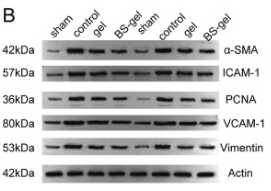
Fig. 6. A: PCNA immunofluorescence staining of venous graft vessels in rats. B, C: Western blot analysis of α-SMA, PCNA, ICAM-1, VCAM-1, and vimentin in rat vein graft vessels. D: ICAM-1 immunofluorescence staining of venous graft vessels in rats. E: qPCR of α-SMA, PCNA, ICAM-1, VCAM-1, and vimentin in rat vein graft vessels. Data are presented as the mean ± SD; *: compared with control group, p < 0.05. #: compared with sham group,

Application: IF/ICC    Species: Rat    Sample:

Fig. 5. A: The rat jugular vein was grafted into the carotid artery, and the gel was wrapped around the vein graft and cured by ultraviolet light. B: Changes in the lumen area of the venous graft in rats after 4 weeks. C: Changes in venous graft vessel blood flow velocity in rats after 4 weeks. D: Four weeks after vein transplantation in rats, the blood vessels of the vein grafts were examined using color Doppler ultrasound. E: H&E and Masson staining of rat venous graft vessels. F: α-SMA immunofluorescence staining of venous graft vessels in rats. Data are presented as the mean ± SD; *: compared with control group, p < 0.05. #: compared with sham group, p < 0.05. (For interpretation of the references to color in this figure legend, the reader is referred to the Web version of this article.)

9). Exosomes of human adipose stem cells mitigate irradiation injury to salivary glands by inhibiting epithelial-mesenchymal transition through miR-199a-3p targeting Twist1 and regulating TGFβ1/Smad3 pathway. Theranostics, 2025 (PubMed: 39897544) [IF=12.4]

10). Nintedanib enhances the efficacy of PD-L1 blockade by upregulating MHC-I and PD-L1 expression in tumor cells. Theranostics, 2022 (PubMed: 34976211) [IF=12.4]

Application: IF/ICC    Species: Mice    Sample: tumor tissue

Figure 2 Image analysis of tumor tissue stained with different stains. (A) Images of tumor tissue stained with hematoxylin-eosin (HE), Ki67, and TUNEL. Quantitative analysis of the (B) Ki67 positive area and (C) TUNEL positive area. (D) Immunofluorescence (IF) images of CD31 and α-SMA in LLC tumor tissue. The quantitative analysis of the (E) CD31+ vessel area and (F) α-SMA+/ CD31+ vessel area. The green scale bar is 100 µm, the white and black scale bar is 200 µm, and the yellow scale bar is 1000 µm.

加载更多

限制条款

产品的规格、报价、验证数据请以官网为准,官网链接:www.affbiotech.com | www.affbiotech.cn(简体中文)| www.affbiotech.jp(日本語)

产品的数据信息为Affinity所有,未经授权不得收集Affinity官网数据或资料用于商业用途,对抄袭产品数据的行为我们将保留诉诸法律的权利。

产品相关数据会因产品批次、产品检测情况随时调整,如您已订购该产品,请以订购时随货说明书为准,否则请以官网内容为准,官网内容有改动时恕不另行通知。

Affinity保证所销售产品均经过严格质量检测。如您购买的商品在规定时间内出现问题需要售后时,请您在Affinity官方渠道提交售后申请。

产品仅供科学研究使用。不用于诊断和治疗。 

产品未经授权不得转售。

Affinity Biosciences将不会对在使用我们的产品时可能发生的专利侵权或其他侵权行为负责。Affinity Biosciences, Affinity Biosciences标志和所有其他商标所有权归Affinity Biosciences LTD.