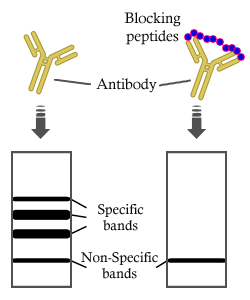
产品: KLF2 抗体
货号: DF13602
描述: Rabbit polyclonal antibody to KLF2
应用: WB IHC
文献验证: WB
反应: Human, Mouse, Rat
预测: Chicken, Xenopus
蛋白号: Q9Y5W3
RRID: AB_2846621

浏览相似产品>>

   规格 价格 库存
 50ul RMB¥ 1250 现货
 100ul RMB¥ 2300 现货
 200ul RMB¥ 3000 现货

货期: 当天发货

联系销售

产品描述

来源:
Rabbit
应用:
WB 1:500-1:2000, IHC 1:50-1:200
*The optimal dilutions should be determined by the end user. For optimal experimental results, antibody reuse is not recommended.
*Tips:

WB: 适用于变性蛋白样本的免疫印迹检测. IHC: 适用于组织样本的石蜡(IHC-p)或冰冻(IHC-f)切片样本的免疫组化/荧光检测. IF/ICC: 适用于细胞样本的荧光检测. ELISA(peptide): 适用于抗原肽的ELISA检测.

反应:
Human, Mouse, Rat
克隆:
Polyclonal
特异性:
KLF2 Antibody detects endogenous levels of total KLF2.
RRID:
AB_2846621
引用格式: Affinity Biosciences Cat# DF13602, RRID:AB_2846621.
偶联:
Unconjugated.
纯化:
The antiserum was purified by peptide affinity chromatography using SulfoLink™ Coupling Resin (Thermo Fisher Scientific).
保存:
Rabbit IgG in phosphate buffered saline , pH 7.4, 150mM NaCl, 0.02% sodium azide and 50% glycerol. Store at -20 °C. Stable for 12 months from date of receipt.
别名:

展开/折叠

KLF 2; Klf2; KLF2_HUMAN; Krueppel-like factor 2; Kruppel like factor 2; Kruppel like factor; Kruppel like factor LKLF; Kruppel-like factor 2 (lung); Lklf; Lung krueppel like factor; Lung krueppel-like factor; Lung Kruppel like zinc finger transcription factor;

抗原和靶标

免疫原:

A synthesized peptide derived from human KLF2, corresponding to a region within the internal amino acids.

基因/基因ID:

研究领域

· Environmental Information Processing > Signal transduction > FoxO signaling pathway.   (View pathway)

· Environmental Information Processing > Signal transduction > Apelin signaling pathway.   (View pathway)

文献引用

1). TRβ activation confers AT2-to-AT1 cell differentiation and anti-fibrosis during lung repair via KLF2 and CEBPA. Nature communications, 2024 (PubMed: 39375377) [IF=16.6]

Application: WB    Species: Mouse    Sample:

Fig. 6: TRβ modulates KLF2 and CEBPA to drive the expression of AT1 cell marker genes. a Principal component analysis (PCA) of TFs in bulk RNA-Seq of mouse lung (same as Fig. 3c, n = 3). The lower and upper bounds of the boxplot correspond to the first and third quartiles (the 25th and 75th percentiles); whiskers represent minima/maxima or 1.5*IQR. b Histogram showing the contributions of TFs in PC.2 and PC.5. c, d Protein and mRNA levels (n = 3) of KLF2 and CEBPA in the mouse lung, as shown in Fig. 3a. e qPCR analysis of KLF2 and CEBPA expression in isolated AT2 cells from mice (n = 3). f, g Immunoblotting and qPCR analysis (n = 3) of KLF2 and CEBPA in A549 and MLE12 with a GC-1 gradient. h The mRNA level of Klf2 and Cebpa in primary AT2 cells after 10 nM GC-1 treatment for 6 h (n = 3). i–l Protein (i, k) and mRNA (j, l) tests of AT1 cell markers, KLF2, and CEBPA expression in A549 after KLF2 (i, j) and CEBPA (k, l) overexpression (n = 3). m Luciferase activity of KLF2, CEBPA, and AT1-marker promoters cloned in pGL3.0 after THRB transfection for 36 h with or without GC-1 10 nM for 12 h (n = 3). Values were normalized to the transfection vector. n, o Luciferase activity of indicated promoters after KLF2 (n) and CEBPA (o) transfection with 600 ng plasmid for 36 h (n = 3). p–r TRβ (p), KLF2 (q), and CEBPA (r) bind to the promoter regions (pro) of KLF2, CEBPA, and AT1 cell genes in ChIP q-PCR assays (n = 3). KRT5 promoter as negative control. Values were normalized to IgG. s Luciferase activity of AT1-maker promoters with KLF2 (300 ng) and CEBPA (300 ng) co-transfection for 36 h, as shown in (n, o) (n = 3). t IF image of KLF2 and CEBPA after co-transfection in A549. Scale bar, 10 μm. u CoIP of KLF2 and CEBPA overexpressed in A549. v Illustration of the regulatory processes of GC-1 on AT1 cell markers. The value of n indicates biologically independent samples. Similar results were repeated in two biologically independent experiments. The statistical tests used were one-way ANOVA (d, e, and g), two-tailed unpaired Student’s t test (h), and two-way ANOVA (j, l, m–s). Data are mean ± SEM.

2). DNMT aberration-incurred GPX4 suppression prompts osteoblast ferroptosis and osteoporosis. Bone research, 2024 (PubMed: 39617773) [IF=14.3]

3). FGF2 Alleviates Microvascular Ischemia-Reperfusion Injury by KLF2-mediated Ferroptosis Inhibition and Antioxidant Responses. International journal of biological sciences, 2023 (PubMed: 37705747) [IF=8.2]

Application: WB    Species: Mouse    Sample:
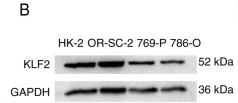
Figure 6 FGF2 reduces oxidative stress and ferroptosis via KLF2-NFE2L2 pathway in vivo. (A) Skeletal muscle specimens were used for the KLF2 and NFE2L2 WB assay. (B) Protein quantification of KLF2 and NFE2L2 from (A), normalised to GAPDH band density and histone 3 band density, respectively. (C) Skeletal muscle specimens showing HO-1, SOD1, SLC7A11, 4-HNE, and GPX4 on a WB assay. (D) Quantification of the GAPDH band density-normalized HO-1 and SOD1 protein levels from (C). (E) Quantification of protein level of SLC7A11, 4-HNE and GPX4 from (C) with normalized to GAPDH band density. (F) DAPI staining shows the nuclei in these micrographs of skeletal muscle slices that have been immunostained for KLF2 and CD31. Scale bars: 100 μm. (G) Micrographs of skeletal muscle slices with NFE2L2 and CD31 immunostaining; DAPI labelling shows nuclei. Scale bars: 100 μm. (H) Quantification of cells that co-express KLF2 and CD31; proportions of co-expressing cells to all CD31-positive cells are shown. (I) Quantification of NFE2L2 and CD31 double-positive cells, the ratio of co-expressing cells to all CD31-positive cells is shown. (J) Micrographs of skeletal muscle slices with nuclei identified by DAPI labelling and DHE and 4-HNE staining. Scale bars: 100 μm. Based on the immunofluorescence data in (J), the ROS level was quantified in (K). Based on the immunofluorescence results in (J), 4-HNE fluorescence intensity was quantified in (L). (M) Content of Fe2+ was plotted as a histogram. (N) The concentration of MDA is shown as a histogram. (O) The concentration of GSH is shown as a histogram. Data are provided as mean ± SD (n = 3-5 per group). Significance: ns, not significant; *P < 0.05.

4). Netrin-1 protects blood-brain barrier (BBB) integrity after cerebral ischemia-reperfusion by activating the Kruppel-like factor 2 (KLF2)/occludin pathway. Journal of biochemical and molecular toxicology, 2024 (PubMed: 38229322) [IF=3.2]

5). Bioinformatics analysis of KLF2 as a potential prognostic factor in ccRCC and association with epithelial‑mesenchymal transition. Experimental and Therapeutic Medicine, 2022 (PubMed: 35978925) [IF=2.4]

Application: WB    Species: Human    Sample: HK-2 cells

Figure 3 KLF2 inhibits ccRCC migration in vitro and KLF2 protein expression is decreased in high pathological grade tissue (II + III). (A) Expression of KLF2 mRNA in ccRCC and normal HK-2 cells. (B) Western blotting was used for assessment of KLF2 protein levels in ccRCC and normal HK-2 cells. (C) Western blotting assessment of KLF2 OE in 769-P and 786-O cells. (D) Migration of 769-P and 786-O cells after wounding (magnification, x40). (E) compared with NC. (F) Immunohistochemistry and (G) analysis of the KLF2 expression in ccRCC tissue (n=20). **P<0.01 vs. stage I and ***P<0.001 vs. NC. KLF, Krüppel-like factor; ccRCC, clear cell renal cell carcinoma; NC, negative control; OE, overexpression.

限制条款

产品的规格、报价、验证数据请以官网为准,官网链接:www.affbiotech.com | www.affbiotech.cn(简体中文)| www.affbiotech.jp(日本語)

产品的数据信息为Affinity所有,未经授权不得收集Affinity官网数据或资料用于商业用途,对抄袭产品数据的行为我们将保留诉诸法律的权利。

产品相关数据会因产品批次、产品检测情况随时调整,如您已订购该产品,请以订购时随货说明书为准,否则请以官网内容为准,官网内容有改动时恕不另行通知。

Affinity保证所销售产品均经过严格质量检测。如您购买的商品在规定时间内出现问题需要售后时,请您在Affinity官方渠道提交售后申请。

产品仅供科学研究使用。不用于诊断和治疗。 

产品未经授权不得转售。

Affinity Biosciences将不会对在使用我们的产品时可能发生的专利侵权或其他侵权行为负责。Affinity Biosciences, Affinity Biosciences标志和所有其他商标所有权归Affinity Biosciences LTD.